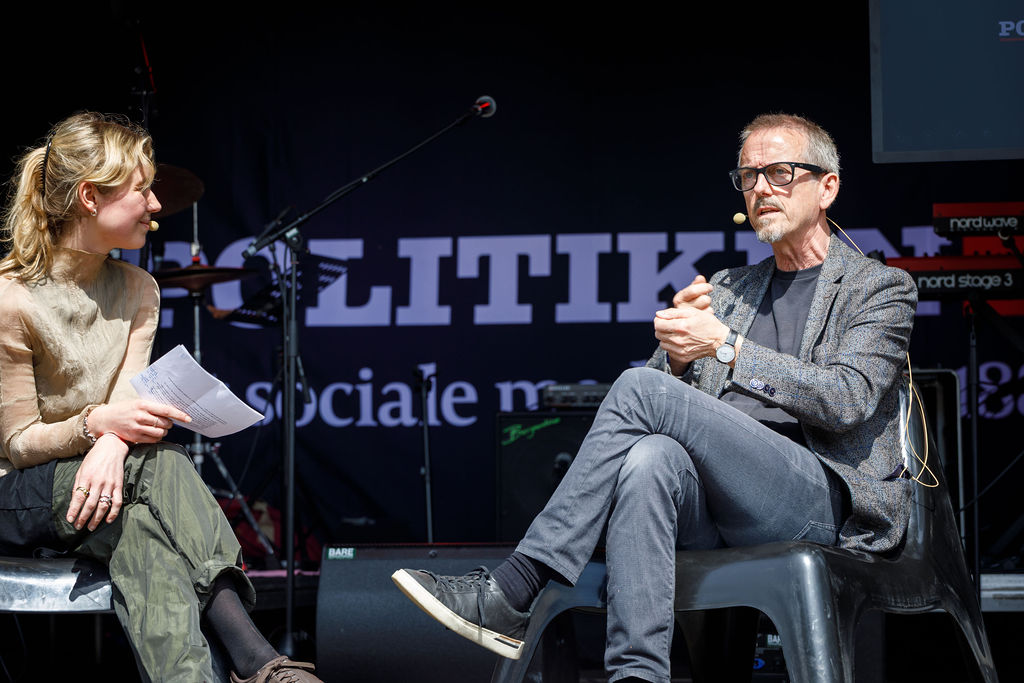
Inclusive architecture is also about democracy

Inclusion is about something different and much more than, for example, providing access to buildings for those who walk with difficulty. It is also about ensuring that everyone can be part of the community and take part in the conversation that democracy is made of. This is what architecture professor Peter Thule Kristensen says.
Architects face a major task when it comes to inclusion. Even though Denmark often prides itself on being a frontrunner, we are in fact somewhat behind in terms of inclusion in the built environment compared with countries we usually measure ourselves against. This is the view of Peter Thule Kristensen, Professor of Architecture at the Royal Danish Academy. He points out that there is often a kind of scepticism, unease or irritation associated with having to address inclusion.
“Typically, when you have worked as an architect, you may have experienced a sense of irritation that now we also have to take into account that people in wheelchairs must be able to get in. And we have to consider people with visual impairments, and really it does not quite fit into the architectural concept we have developed, and perhaps it does not quite suit the colour scheme to have yellow markings on the platform,” he explains.
Fortunately, he does see signs that architects’ attitudes are beginning to change, with more and more people no longer viewing inclusion merely as an annoying constraint.
“I increasingly see that it may have dawned on more architects that it is not just about adding a few yellow lines in the asphalt or a ramp, but rather about creating an architecture that is not designed solely for these Vitruvian or Le Corbusian ideal humans, but for people as they actually are. And that the idea of inclusion can in fact shape architecture in a positive way,” he observes.
By ‘Vitruvian ideal humans’, he is referring to Leonardo da Vinci’s famous drawing The Vitruvian Man (Homo ad Circulum) from around 1490. In the drawing, da Vinci explored whether the human body could fit within both a circle and a square. It depicts an athletic male body whose proportions are so perfectly calibrated that, with the navel at the centre, the body fits neatly inside a circle.
The idea of an ideal human being is also reflected in the work of the Swiss French architect and visual artist Le Corbusier. In the 1940s, he developed a proportional system known as The Modulor, which he used to calculate the ideal dimensions for his buildings. The system is based on the measurements of a man with a height of 183 centimetres.
Great potential in thinking beyond the ideal
Peter Thule Kristensen does not only see a challenge. He sees real potential in thinking inclusively and in moving beyond an architecture geared solely towards an idealised conception of what the human body looks like. This also means abandoning the add-on mindset, where inclusion is understood as adding special solutions for specific groups of people, such as a ramp or an elevator for wheelchair users. Instead, it is about recognising that inclusion concerns all of us.
“We still tend to think of it as an add-on. And I think many people overlook that inclusion of, for example, people with mobility impairments is not only about including someone who uses a wheelchair. It is also about the fact that all of us, sooner or later, may need it,” he emphasises.
As he elaborates, any of us can break a leg, be involved in a traffic accident, or have a child who has an accident and is then unable to visit us in the flat where we live.
Inclusion is therefore about more and something different than simply ensuring that people who, for instance, have difficulty walking can get in and out of buildings. It is also about community and democracy, or about conversation, if one looks to the theologian Hal Koch’s famous dictum.
“It is also about enabling those who, for example, do not walk well to become part of the community. In reality, one could say that it may also be about democracy. If, as Hal Koch says, democracy is conversation, then it may also be about giving people the opportunity to be part of that conversation,” he concludes.
The video is part of a series of 12 films in which we invite experts and prominent voices in society to share their reflections on how an inclusive view of humanity can help shape and transform our shared future. The films were produced in connection with the Bevica Foundation’s 150th anniversary.
1 Niels Bohr Instituttet, Københavns Universitet: Leonardo da Vinci og renæssancen, på www.nbi.ku.dk
Direkte link: https://nbi.ku.dk/hhh/videnskaben_i_kunsten/kapitler/renaessancen/
2 Louring Nielsen, S., Ryhl, C., Eiriksson, M., Overby Sørensen, R. (2024): Vil du skabe en mere inkluderende verden? så bør du gå op i inkluderende design, på www.videnskab.dk
Direkte link: https://videnskab.dk/kultur-samfund/vil-du-skabe-en-mere-inkluderende-verden-saa-boer-du-gaa-op-i-universelt-design/
3 Møller, Vibeke Andersson: Le Corbusier, i Lex – Danmarks Nationalleksikon på lex.dk
Direkte link: Le Corbusier – Lex
4 Dansk Arkitektur Center (2019): Le Corbusiers idealby var som en park af geometriske former, på www.dac.dk/magazine
Direkte link: https://dac.dk/magazine/le-corbusiers-idealby-var-som-en-park-af-geometriske-former
Peter Thule Kristensen is Professor of Architecture at the Institute of Architectural Design and Technology at the Royal Danish Academy. He is Head of the Master’s Programme in Spatial Design at the same institution and is also a core researcher at the Centre for Privacy Studies at the University of Copenhagen.
See Peter’s research profile:
Peter Thule Kristensen - Arkitektur, Design og Konservering - Dansk portal for forskning og KUV
More knowledge about Universal Design
Explore the Bevica Foundation's Knowledge Library
.png)
Latest News
Follow the latest news from the Bevica Foundation below.
.png)