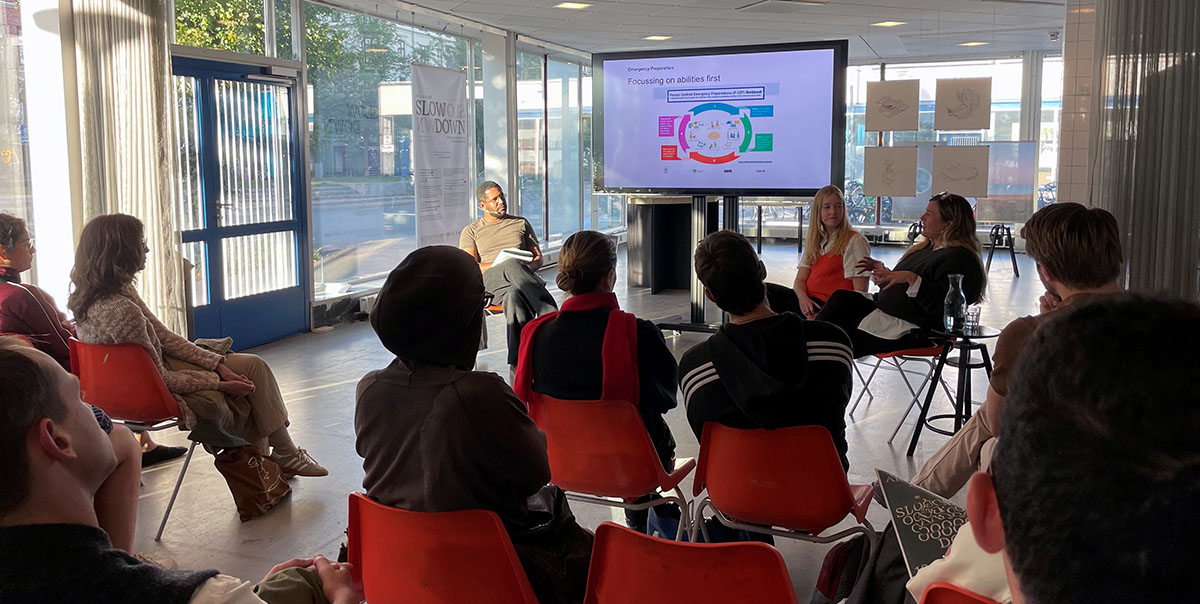
Universal design gives everyone a seat at the table — co-design is important in the process

When we design spaces, we also decide who gets a seat at the table — and who gets left out. Professor Janice Rieger, internationally renowned expert and researcher, points to universal design and co-design as the path to real inclusion.
Ableism is embedded in the way we build our surroundings and therefore also reflects the power structures in our society. This means, according to one of the experts in the field, Dr Janice Rieger, that people with disabilities are excluded in many contexts—they don’t have a seat at the table, and their voices are often not heard. She highlights:
“We do create a lot of obstacles and a lot of exclusion in the way that we create space. And a lot of power is manifested in the way we create these injustices in space.”
Dr Janice Rieger is a professor at Griffith University and researches accessibility, inclusion, and universal design. She works with the concept of Spatial Justice and has many years of experience in research and teaching on universal design, as well as accessibility and access in the built environment.
Co-design: The lived experience as knowledge
Developers and architects often believe that spaces and buildings are accessible or universally designed, even though they still contain barriers in practice—and therefore end up excluding people with disabilities.
This is something Janice Rieger has often observed through her work. That is also why she knows how important co-design is as a method for creating access, representation, and equality in the built environment. When this way of working is placed at the center of the process, Rieger argues, we can include the lived experiences of people with disabilities. In this context, it is important to focus on physical, sensory, and psychological variations—ranging from wheelchair users and people with visual and hearing impairments to, for example, neurodiversity.
“Universal design is not just a ‘nice to have’. It is a right. It is a human right,” she emphasizes.
With universal design as a prism, we gain the opportunity to rethink our built environment and to create what Rieger calls Spatial Justice:
“If we create spaces, products, and services that are not universally designed, then they are really useless for a majority of the population. It is really important that we start to think about how we universally design things to create a just and inclusive environment.”
Rieger stresses that it is essential for legislators, politicians, and architects to understand that universal design is not only about removing barriers, but about a more holistic approach that ensures all bodies can take part.
The Bevica Foundation met Dr Janice Rieger in Oslo at the UD2024 conference. The interview above is from that meeting.
More knowledge about Universal Design
Explore the Bevica Foundation's Knowledge Library
.png)
Latest News
Follow the latest news from the Bevica Foundation below.
.png)