Bevica Foundation and Youth Agency enter into partnership on universal design in work with youth and democracy
All young people must have a real opportunity to participate in democratic communities, regardless of their body and functional abilities. That is why the Bevica Foundation and the Youth Agency enter into a five-year strategic partnership to enshrine universal design as a fundamental approach throughout the Youth Agency's practice.
The Bevica Foundation and the Youth Agency enter into a five-year partnership to strengthen young people's access to democratic communities. The Bevica Foundation will provide a grant of DKK 5,716,131, which will run over the next five years until the end of 2030.
The partnership focuses on integrating universal design into the Youth Bureau's strategy, structures, workflows and culture. This applies both in the development and implementation of projects, in communication, in collaborations and in daily work with young people. The partnership thus moves from strategy and structure to practice and culture. The ambition is to make universal design a basic condition of the Youth Agency's work, not as a supplement, but as a common approach that shapes the organization's decisions, priorities and way of working. The aim is for all young people, including young people with disabilities, to experience the Youth Agency as a platform where they can participate and belong on equal terms.
The partnership has emerged in recognition of the fact that many communities, formats and democratic arenas today are designed around the notion of the existence of a 'body of norms'. The Youth Agency wants to move away from that approach by making universal design a permanent and fixed principle in the work of the entire organization. Change begins in the organization itself. Before universal design can create change through the activities of the Youth Bureau, the understanding of universal design and the underlying philosophy must be rooted in the organization's own practices. It is about building a common understanding that can be translated into everyday life and forms the basis for the way the agency develops and conducts its activities.
This is according to Olivia Orlandi Grant, deputy director of the Youth Bureau
“At the Youth Agency, we work every day with young people, democracy and communities, and we see that too many young people encounter barriers before they even have the opportunity to participate. It is not about lack of desire, but about formats and structures that are not designed for diversity. That is why it is crucial for us to enter into this partnership. With universal design at the heart of the organisation, we will change our own way of working so that more young people can engage in what they are passionate about on a level playing field.”
Continually evolving
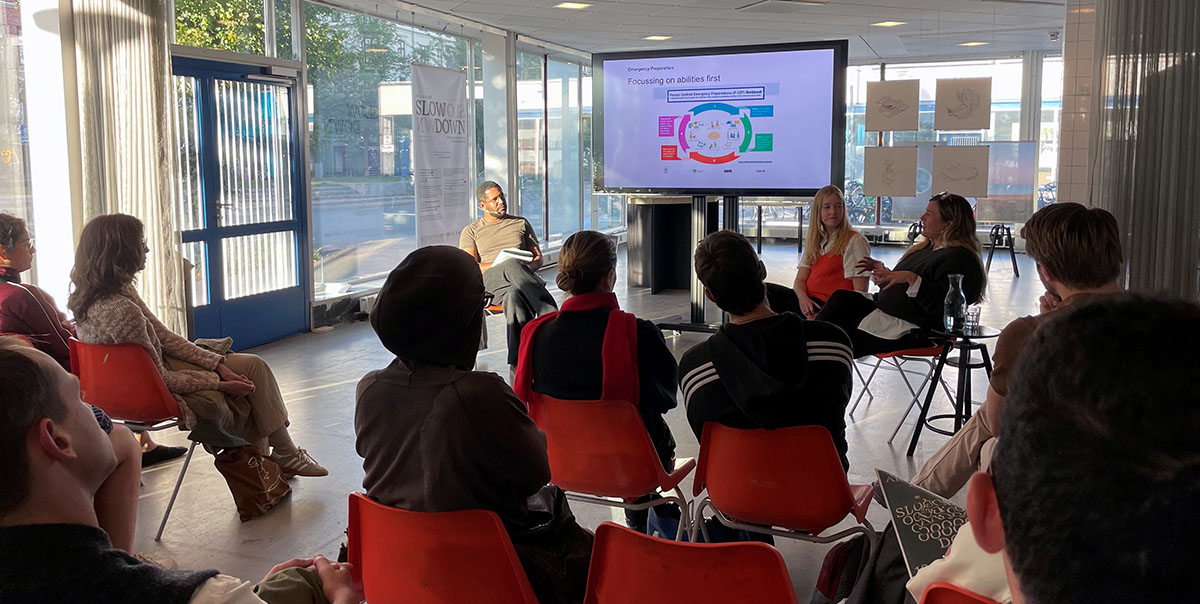
The cooperation is not organized as a single concrete project, but as an ongoing development process, where learning, testing and anchoring go hand in hand. By testing concrete initiatives in existing activities, for example at the Youth Folk Meeting, experience and knowledge are built up, which are gradually translated into new practice. The ambition is that universal design should not be an independent theme, but a natural and consistent part of the Youth Agency's way of working.
The youth agency thus also continuously draws on the Bevica Foundation's knowledge and experience with universal design as well as the foundation's Universal Design Hub, which contributes perspectives, sparring and qualification of the efforts.
It is important for the Youth Agency that universal design is embedded throughout the organisation, says Camilla Gregersen, Director of the Youth Agency:
“For us, universal design is a fundamental value choice about community and participation. We want to create solutions that work for everyone from the beginning — across different assumptions.”
“We will try things out and adjust along the way, which is why it is valuable to be able to draw on the knowledge and experience of the Bevica Foundation. The interplay of practice, reflection and anchoring is what should make universal design a natural part of our way of working.”
Looking forward to the cooperation
The partnership between the Bevica Foundation and the Youth Agency is a strategic collaboration focused on lasting change. The ambition is to truly embrace all young people from the beginning, so that communities, formats and platforms are created with human diversity as a starting point, and thus the Youth Agency becomes an important inspiration for how universal design can be put into practice, says Marianne Kofoed, Director of the Bevica Foundation.
“When participation is not available to everyone, it is not democratic. With this partnership, we want to support a fundamental change in which universal design becomes a guiding principle in the work with youth and democracy, and I am really looking forward to seeing how a strong and important organisation like the Youth Agency will lift the task and inspire others — both in our other partnerships and beyond.”
Who is the Bevica Foundation?
The Bevica Foundation is a Danish philanthropic foundation with roots dating back to 1872. The Foundation's work aims to strengthen opportunities for people with different functional abilities to live independent and equal lives. Today, universal design is a key focal point in the work and an important lever in relation to Denmark's obligations under the UN Convention on Disability and the World Goals principle of “Leave No One Behind”.
Who is the Youth Agency?
The Youth Bureau is a nonprofit organization that since 2013 has been working with youth, democracy and civic engagement. The youth bureau is responsible for, among other things, the democracy festival UngFolkemød, the project academy ASU — The Academy of Community Engaged Young People and the book series De [Serien]. Through our projects, we work to create conditions for young people's engagement in society and decision-makers' engagement with young people.

Latest News
Follow the latest news from the Bevica Foundation below.
.png)