Niklas Kline Lange Frost
Inclusive by Law, Exclusive by Design? Currents and Futures of the Digital Divide
This project explores why digital spaces continue to replicate accessibility barriers from the physical world, and how AI-driven solutions might help or hinder efforts toward truly inclusive design. The goal is to map the key factors shaping digital accessibility today, particularly in Europe, and to examine how universal design principles can be better applied to create spaces that go beyond compliance to genuine inclusion.
The research will take place at European Digital Rights (EDRi) in Belgium and the Inclusive Design Research Centre (IDRC) in Canada. Niklas will also participate at major conferences including CHI, DIS, ASSETS, and W3C TPAC, contributing to the global conversation on accessible digital futures.
Watch Niklas´ pitch here:
Follow
Niklas Kline Lange Frost
's investigation
Niklas has begun his investigation. Below, you can read posts from his journey, where he describes his experiences and the insights he has gained so far.
June 2026

Singapore is hot and humid, so I’m sweaty about five minutes after stepping outside. It’s also incredibly inspiring. The DIS conference is held at the National University of Singapore (NUS) and is filled with people working on various aspects of Human-Computer Interaction design. I’ve connected with a bunch of new people—some whose work I was already familiar with, and many others working on ideas I had never heard of before.
I attended two sessions specifically focused on different aspects of accessibility that were directly transferable to the project. A lot of inspiration, but also a quite humbling experience. People are doing such great work trying to make aspects of digital life more inclusive: on-the-fly generated alt text for slides in live presentations, non-visual 3D printer interfaces so blind and low-vision individuals can design and print models, studies on live-streamers with autism, and an endless amount of other projects.
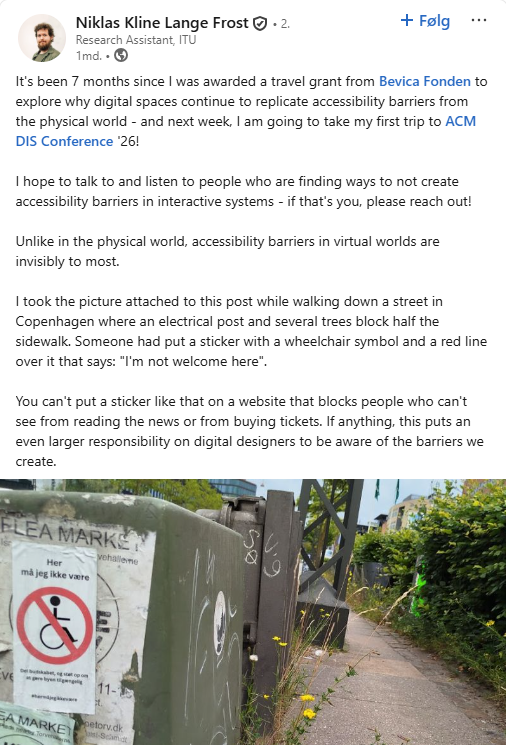
The conference also gave me the opportunity to connect with a handful of researchers from ITU, which was also quite amazing. It feels like a transition of sorts, going from completing my master’s studies (LAST WEEK!!!) to having more of a peer relationship with the researchers at ITU. The image shows the group from ITU at the conference in front of one of the university's large signs.
I’m heading home from this trip now that the conference is ending, but I’ll be going to Germany in September for another conference, which I’m also looking forward to—after some rest!!!
July 2026